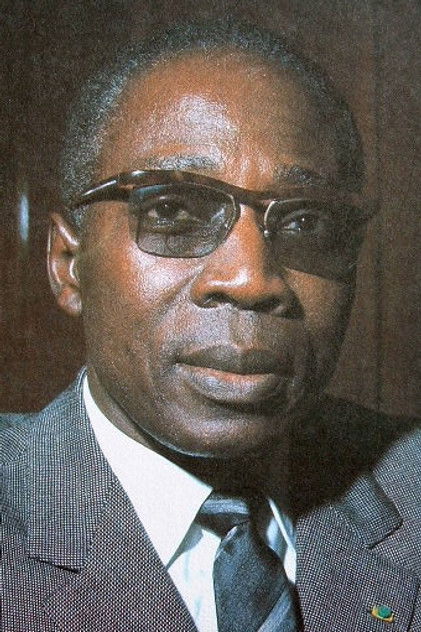
Léopold Sédar Senghor
ActorWriter
Léopold Sédar Senghor (9 October 1906 – 20 December 2001) was a Senegalese poet, politician and cultural theorist who was the first president of Senegal (1960–80).
Ideologically an African socialist, he was the major theoretician of Négritude. Senghor was a proponent of African culture, black identity and African empowerment within the framework of French-African ties. He advocated for the extension of full civil and political rights for France's African territories while arguing that French Africans would be better off within a federal French structure than as independent nation-states.
Senghor became the first President of independent Senegal. He fell out with his long-standing associate Mamadou Dia who was Prime Minister of Senegal, arresting him on suspicion of fomenting a coup and imprisoning him for 12 years. Senghor established an authoritarian single-party state in Senegal where all rival political parties were prohibited.
Senghor was also the founder of the Senegalese Democratic Bloc party. Senghor was the first African elected as a member of the Académie française. He won the 1985 International Nonino Prize in Italy. He is regarded by many as one of the most important African intellectuals of the 20th century.
Léopold Sédar Senghor was born on 9 October 1906 in the city of Joal, some 110 kilometres south of Dakar, capital of Senegal. His father, Basile Diogoye Senghor (pronounced: Basile Jogoy Senghor), was a wealthy peanut merchant belonging to the bourgeois Serer people. Basile Senghor was said to be a man of great means and owned thousands of cattle and vast lands, some of which were given to him by his cousin the king of Sine. Gnilane Ndiémé Bakhoum (1861–1948), Senghor's mother, the third wife of his father, a Muslim with Fula origin who belonged to the Tabor tribe, was born near Djilor to a Christian family. She gave birth to six children, including two sons. Senghor's birth certificate states that he was born on 9 October 1906; however, there is a discrepancy with his certificate of baptism, which states it occurred on 9 August 1906. His Serer middle name Sédar comes from the Serer language, meaning "one that shall not be humiliated" or "the one you cannot humiliate". His surname Senghor is a combination of the Serer words Sène (a Serer surname and the name of the Supreme Deity in Serer religion called Rog Sene) and gor or ghor, the etymology of which is kor in the Serer language, meaning male or man. Tukura Badiar Senghor, the prince of Sine and a figure from whom Léopold Sédar Senghor has been reported to trace descent, was a c. 13th-century Serer noble.
At the age of eight, Senghor began his studies in Senegal in the Ngasobil boarding-school of the Fathers of the Holy Spirit. In 1922 he entered a seminary in Dakar. After being told the religious life was not for him, he attended a secular institution. By then, he was already passionate about French literature. He won distinctions in French, Latin, Greek and Algebra. With his Baccalaureate completed, he was awarded a scholarship to continue his studies in France. ...
Source: Article "Léopold Sédar Senghor" from Wikipedia in English, licensed under CC-BY-SA 3.0.
09-10-1906
Birthday
Libra
Zodiac Sign
-
Genres
6
Total Films
Also known as (male)
Joal-la-Portugaise, Senegal
Place of Birth
09-10-1906
Birthday
Libra
Zodiac Sign
-
Genres
6
Total Films
Leopold Sedar Senghor
Also Known As (male)
Joal-la-Portugaise, Senegal
Place of Birth