


Reynold Reynolds
Director
-
Birthday
-
Zodiac Sign
-
Genres
0
Total Films
Also known as (male)
Place of Birth
-
Birthday
-
Zodiac Sign
-
Genres
0
Total Films
-
Also Known As (male)
-
Place of Birth
-
Birthday
-
Zodiac Sign
-
Genres
0
Total Films
Also known as (male)
Place of Birth
-
Birthday
-
Zodiac Sign
-
Genres
0
Total Films
-
Also Known As (male)
-
Place of Birth
actor
0 Works
producer
0 Works
director
16 Works
writer
0 Works
other
1 Works
2 part 7
2 Part 7 has at its center two fast fading 20th century media; black and white television, and long play records. Both came to prominence in the late 1950s and early 1960s adding to the popular vocabulary “Stereo“, “High Fidelity“, and “The Medium is the message”.Year:
2015
Die Verlorenen
Year:
2015
1 Part 7
1 Part 7 takes as its point of departure a Renaissance image that purports to demonstrate the rules of linear mathematical perspective, to take up historically similar questions of experience and of self. The work connects its own exploration of often-troubled relationships between viewing positions, visual technologies, and notions of modernity, “back to a far earlier period, when the very notion of a ‘technology of viewing’ was first being forged.” It offers a simultaneous crashing together of linear perspective, anamorphosis, and sfumato, together with other visual modes and systems, implicitly comparing early Renaissance revisions to perspective to those realized through digital technology. This raises issues of the possibility of permeable boundaries among objects and between physical and virtual worlds, and radical revisions of notions of space and scale.Year:
2014
Last Day of the Republic
The Palast der Republik (Palace of the Republic) opened in 1976 as a meeting place for the East German people and an emblem of the future. The unique modern building made of distinctive golden-mirrored windows was home to not just the East German Parliament but also auditoriums, art galleries, five restaurants, concert halls, and even a bowling alley. The building's dazzling public lobby, surrounded by several tiers, was once the center of social life in East Berlin with thousands of sparkling lamps filling the open space of the lobby's grand staircase.Year:
2010
Six Easy Pieces
Six Easy Pieces is based on the book "Six Easy Pieces: Essentials of physics explained by its most brilliant teacher" by Richard P. Feynman. It brings together the foundations of "Film as the Seventh Art; a superb conciliation of the 'Rhythms of Space' and the 'Rhythms of Time'" by Ricciotto Canudo and "Music is the pleasure the human mind experiences from counting without being aware that it is counting" by Gottfried Leibniz. The work deconstructs film as the perfect synthesis of art and technology. Connecting art and science, it romantically refers to an age when artists and scientists had similar concerns and were often one and the same person.Year:
2010
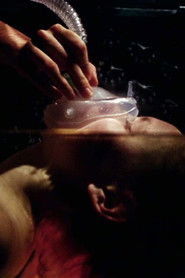
Secret Machine
In Secret Machine, the protagonist encounters an antagonist that is studying her, measuring her body and comparing her to units of space and time. Clocks rush and her movements are calculated on a grid: the eye is observed through lenses; her breath is submitted to a resistance rate by putting her under water; needles are used to quantify her reactions and pain: and her voice and motion are recorded. For the scientist measurement is understanding. While human nature appears confined in the framework and efforts of rationality, the aspiration of trapping the soul conduce the antagonist to imagine the improvable.Year:
2009
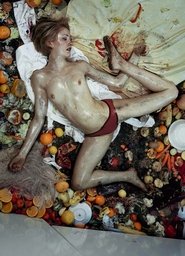
Secret Life
A woman is trapped in an apartment filled with moving plants. She moves at a mechanical speed and her mind functions like a clock whose hands pin the events of her life to the tapestry of time. Her thoughts escape her and come to life, growing like the plants that inhabit the space around her: living, searching, feeling, breathing and dying.Year:
2008
Six Apartments
Yet while it may appear that nothing is happening here, the apartment building and its inhabitants’ bodies are aging, giving way to bacteria, larva, and finally transformation. Televisions and radios tell them about the destruction of the planet but it does not seem to affect their lives. Everything is in a state of resolute conversion. Immense drama does exist: chaos overcomes order and rot supersedes life. The residents’ lives are moving slowly towards death following the deliberate and methodical rhythms of their uniform days. This continuous erosion of bodies, buildings, and the planet, reveals the ever-active potential of death and its material processes.Year:
2007
Phantom Canyon
A curious woman meets an alluring man with bat wings in this personal recollection of a pivotal journey. This 10 minute animated film was created from over 4000 hand-made collages incorporating the figures from Eadweard Muybridge’s Human and Animal Locomotion, first published in 1887. Source : Stacey Stears VimeoYear:
2007
Sugar
A young woman rents a shabby one room apartment, opening the door for visions, nightmares, memories, and revenge.Year:
2005
Based on an Actual Event
A three-channel video installation about the fictional portrayal of American military forces in 20th century war. While each film simulates an actual event, each new war simulates previous wars as shown in popular films. Conceptions of war become reality through the depiction of war as entertainment.Year:
2003
Burn
Burn is a narrative collage, with people and allegorical creatures. A house burns from the inside while its occupants focus on the emotional issues of their lives. The inhabitants serve life sentences with no remission in a structure of insecurity - while impending disaster is ignored. An absent minded couple sits calmly reading as fires erupt in their clothing, books and furniture. They nonchalantly swat at the flames with a stoic inattentiveness. Burn embraces an anti-narrative structure yet intense drama is found in the work. Finally a decisive act is taken leading to the possibility of a miraculous event.Year:
2002
The Last News
Newscaster Guy Smith hosts "MSNBC 24 Disaster Watch & Survival News Channel, reporting on a seemingly endless montage of disasters and terrorist attacks cobbled together from movie footage, all the while attempting to assure the spectator that the U.S. will be victorious against all opposers. As the world devolves into chaos, Smith increasingly loses control and himself, and the broadcast begins to consume him in glitches and static.Year:
2002
The Drowning Room
A sequence of domestic vignettes from the sunken suburbs. In the house, the stagnant atmosphere has slowly thickened to liquid. The inhabitants try to carry on as normal but beyond the borders of asphyxiation; communication is limited and expression difficult. Filmed entirely underwater in a submerged house to create an atmosphere unlike any other film.Year:
2000
Seven Days 'Til Sunday
Seven Days ‘til Sunday, the first of three Jolley/Reynolds film collaborations, is a sequence of short episodes in which headless figures fall through the architecture of New York, incinerate in their own living room, detonate on wet ground. This strange depiction of anonymous, marginalised individuals meeting their end amid relentless urbanisation provides the imagery, but beyond the particularisation of their fates ‘the narrative stands for the tragi-comedy of life itself in a remote, indifferent universe.’Year:
1998
The History of the Future
Reynold Reynolds create works that directly reference and use source material from the Media in order to describe how the Media creates a kind of 'shared consciousness' of how we come to understand our own culture as well as anothers.Year:
1996
